The same window, fewer usable days
Whether you're working under a Florida AS-IS Residential Contract (15-day inspection period), a Texas option period (typically 7–10 days via TAR forms), or Arizona's BINSR window (10 days), the calendar doesn't care how long explanation takes. Every day spent helping your buyer understand the report is a day subtracted from contractor scheduling, repair negotiation, and response time.
For monolingual agents, the post-report workflow is fast: buyer gets the PDF, skims the summary page, calls the agent with two or three questions, and they agree on a repair strategy within hours. The whole explanation step might take 15 minutes because the buyer can read the document independently.
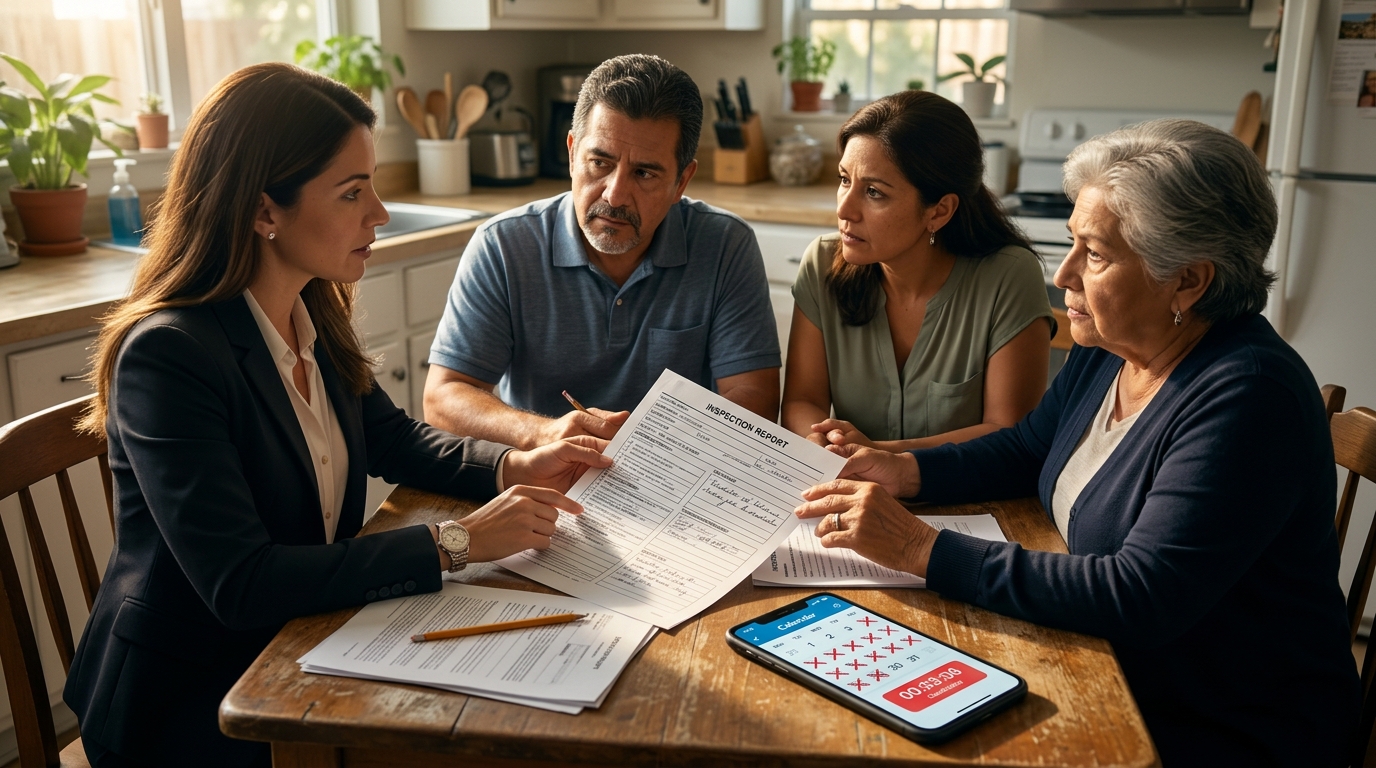
For bilingual agents serving Spanish-speaking buyers, that same step becomes a scheduled meeting. You're translating technical English in real time, drawing diagrams on the back of the report, and answering questions that wouldn't exist if the buyer could read the findings on their own. That meeting takes 60 to 90 minutes — and it's just the first round.
Which report sections cause the longest walkthroughs
Not every section of an inspection report requires the same explanation effort. Some findings translate quickly because they're visual — a cracked tile, a stained ceiling. Others stall the conversation because the terminology has no clean Spanish equivalent and the concept itself is unfamiliar to a first-time buyer.
| Report Section | Key Jargon | Why It Stalls in Spanish | Typical Extra Time |
|---|---|---|---|
| Electrical panel | GFCI, arc-fault breaker, double-tap | No direct equivalent for GFCI; buyer needs to understand why it matters near water | 15–20 min |
| Roofing & flashing | Flashing, soffit, fascia, R-value | Flashing as a concept doesn't map to a single Spanish word; requires visual explanation | 10–15 min |
| Foundation / structural | Efflorescence, spalling, lateral crack | Efflorescence is chemistry — agents end up explaining water migration through concrete | 15–20 min |
| Plumbing | Galvanic corrosion, S-trap, polybutylene | Pipe material risks require context about age and insurance implications | 10–15 min |
| HVAC | Condensate line, refrigerant, heat exchanger | System lifespan and replacement cost dominate the conversation | 5–10 min |
The electrical, roofing, and foundation sections alone can consume 45–55 minutes of walkthrough time. That's before the buyer asks the question that matters most to them: "Is this serious enough to walk away?" Answering that question — in Spanish, with the right framing — is where the real time goes. As we've covered in our breakdown of the [verbal explanation layer in bilingual deals](/blog/bilingual-deal-documents-verbal-explanation-layer), the agent isn't just translating words. They're translating risk.
The family decision unit multiplies every delay
In many Hispanic households, the person who signed the contract isn't the only person making the decision. A spouse who couldn't leave work for the inspection, parents who are helping with the down payment, a sibling who bought a house last year and has opinions — they all need to understand the findings before the family reaches consensus on what to request.
That means the agent's 60–90 minute walkthrough with the buyer often triggers a second walkthrough. Sometimes it's a phone call where the buyer tries to relay findings and the agent gets pulled back in to clarify. Sometimes it's a second in-person meeting. Either way, the information has to pass through the agent again — in Spanish — before anyone agrees on a repair list.
The contingency clock doesn't pause while the family talks it over. Every hour spent on a second explanation round is an hour subtracted from contractor quotes and repair negotiation.
This isn't a cultural problem to fix. It's an operational reality to plan for. The [friction in bilingual deals starts before the contract](/blog/bilingual-deal-friction-starts-before-the-contract), and if you don't account for the family decision unit at the inspection stage, you'll feel the squeeze at the negotiation stage.
Day-by-day: where the timeline actually compresses
Here's what a 10-day inspection contingency looks like in practice for a bilingual deal versus a monolingual one. The contingency period is identical. The usable negotiation time is not.
| Day | Monolingual Deal | Bilingual Deal |
|---|---|---|
| Day 1 | Report received, buyer reviews PDF, agent call (15 min), repair strategy decided | Report received, agent schedules walkthrough for that evening or next day |
| Day 2 | Contractor quote requested, repair list drafted | Agent walks buyer through report (60–90 min), buyer needs to discuss with family |
| Day 3 | Repair request submitted to listing agent | Family follow-up call, second explanation round, repair priorities identified |
| Day 4 | Listing agent responds, negotiation begins | Contractor quote requested, repair list drafted |
| Day 5–8 | Back-and-forth negotiation, contractor scheduling | Repair request submitted — negotiation compressed into fewer days |
| Day 9–10 | Resolution or contingency decision with buffer | Rushed negotiation, possible extension request |
The monolingual agent starts negotiating on Day 3. The bilingual agent starts on Day 5. Same contract, same contingency language, two completely different amounts of leverage.
The downstream cost: weaker negotiations, not just tighter timelines
Timeline compression doesn't just feel stressful — it produces measurably worse outcomes. When you're submitting a repair request on Day 5 instead of Day 3, three things happen that hurt your buyer's position.
- Contractor quotes arrive late or incomplete because you're scheduling them under pressure, so your repair request lacks the specificity that makes a seller take it seriously.
- The listing agent sees a late submission and reads it as disorganization — not a language barrier they can't see — which weakens your credibility in the negotiation.
- If you need an extension, the request signals that your side isn't ready, giving the seller leverage to push back on repairs or offer a lower credit.
None of this is about the substance of the findings. The inspection results are the same. The repair needs are the same. But the agent who had three extra days to build a clean, well-documented request walks into the negotiation with a stronger hand than the one who scrambled to submit something before the deadline.
The pre-inspection briefing packet: reclaim the lost days
The fix isn't faster translation after the report arrives. It's preparation before the inspector shows up. A pre-inspection briefing packet — delivered in Spanish, one to two days before the inspection — gives the buyer the mental model they need to understand findings without starting from zero.
Here's what we've seen work for agents who build this into their bilingual deal workflow:
- A one-page overview in Spanish of what the inspector will check: structure, roof, electrical, plumbing, HVAC, and exterior — with a plain-language description of each category.
- A visual glossary of the five to eight jargon terms that cause the longest stalls: GFCI, flashing, efflorescence, soffit, R-value. Use photos, not definitions.
- A simple framework for how to think about findings: cosmetic (paint, minor cracks, worn fixtures) versus functional (leaking, not up to code, safety hazard) versus structural (foundation, load-bearing, major systems). This framework alone cuts the 'Is this serious?' conversation in half.
- A note explaining that the report will arrive as an English PDF, what it will look like, and that the agent will walk through key findings — so the buyer isn't surprised by a 40-page document they can't read.
- An explicit mention that the buyer should loop in any family members who will be part of the repair decision before the walkthrough — so the agent only explains the findings once.
When the buyer already knows what GFCI means, what flashing looks like, and that a hairline crack in stucco is cosmetic — the post-report walkthrough drops from 90 minutes to 30 or 40. That's an entire day returned to the contingency window.
This isn't a translated inspection report. CFPB and HUD offer some multilingual homebuyer materials, but nothing specific to the inspection stage. The briefing packet is something you build once and reuse across deals — updated as you learn which terms trip up your specific buyer demographic. It's operational preparation, not translation. And it's the difference between negotiating from Day 3 and scrambling from Day 5.


