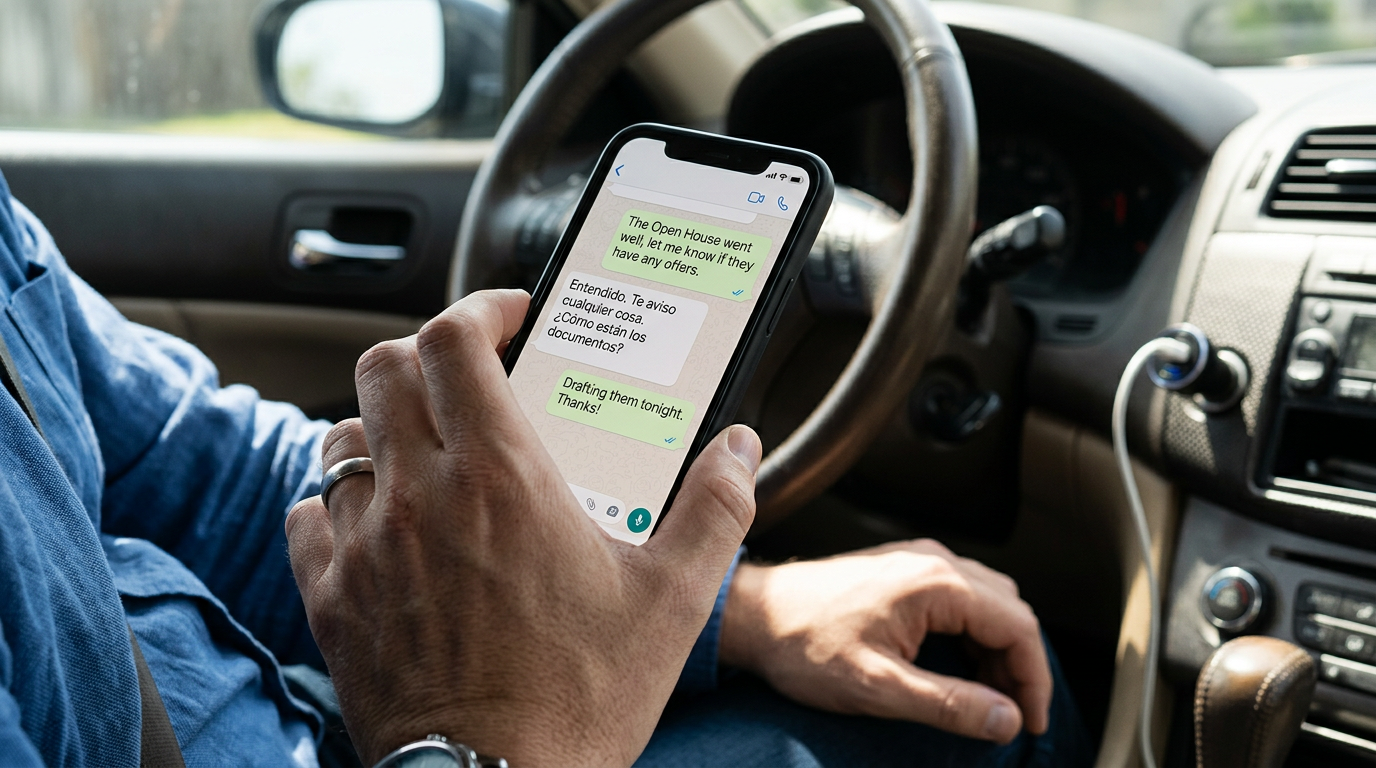
It's not a language problem. It's a workflow problem.
Most people frame bilingual real estate work as a competitive advantage. And it is — on the sales side. Speaking Spanish in a market like South Florida or Houston or LA means you can serve buyers and sellers that other agents can't reach. That's real.
But nobody talks about the operational cost that comes with it.
When a monolingual agent gets a disclosure package from the title company, they read it, flag anything unusual, and forward it to the client. Done.
When you get that same package, you read it, flag anything unusual, figure out how to explain the flagged items in Spanish without using legal terms that don't translate cleanly, write or call your client to walk them through it, then follow up to make sure they actually understood — not just said they did.
Same document. Same deal. Twice the work. And that's one task on one transaction.
Where the friction actually hides
The obvious stuff — translating a listing description, writing a text in Spanish — isn't where most of the time goes. The real drag is in the places you'd never think to count.
**Document explanation, not just translation.** Most transaction documents are in English. Your Spanish-speaking clients aren't asking you to translate word-for-word. They need you to explain what the document means, why it matters, and what they should do about it. That's interpretation work, and it takes significantly more time and care than forwarding a PDF.
**Tone management across languages.** The way you reassure a nervous first-time buyer in Spanish is not the same phrasing translated from English. Cultural context matters. Formality levels differ. A message that sounds warm and professional in English can land as cold or distant if you just translate it. So you end up writing two versions of the same update — not because the information changed, but because the delivery has to change.
**Vendor coordination gaps.** Your lender sends updates in English. Your client asks questions in Spanish. You're the relay. And it's not just passing messages — you're reformulating questions so the lender gets a clear ask, then reformulating answers so the client gets a clear explanation. Every vendor touchpoint becomes a three-step process instead of a two-step one.
**Follow-up sequences that only exist in your head.** If you're using any kind of CRM or follow-up system, it almost certainly runs in English. So your Spanish-speaking leads either get English templates — which feel impersonal and sometimes confusing — or they get nothing automated at all, because you haven't had time to build a parallel Spanish sequence. The result is that your bilingual follow-up depends entirely on you remembering to do it manually.
The context-switching tax nobody measures
Here's something that doesn't show up on any time tracker: the mental cost of switching languages dozens of times a day.
You take a call from a title company in English. You hang up and text your client in Spanish. You open your laptop to draft an offer addendum in English. You get a WhatsApp voice note in Spanish from another client asking about inspection timelines. You switch back to email to respond to your broker — in English.
Each of those switches isn't just a language change. It's a cognitive reset. You're adjusting vocabulary, tone, formality, even the way you structure a sentence. Research on bilingual cognition calls this 'switching cost,' and it's real. It doesn't mean you're slow. It means the work is genuinely harder, and it accumulates across a full day.
By 4 PM, you're not just tired from working. You're tired from translating your entire workday in real time — and you probably haven't made a single prospecting call.
Why 'just hire a translator' doesn't fix it
The instinct most people have is straightforward: if language is the bottleneck, hire someone who speaks both languages.
But the problem isn't vocabulary. It's context.
A translator can turn an English sentence into a Spanish sentence. What they can't do — without deep real estate knowledge — is explain to your client why the appraisal came in low, what their options are, and why they shouldn't panic. That requires transaction knowledge, client rapport, and judgment. It's not a translation task. It's a relationship task that happens to cross a language boundary.
The same goes for generic AI translation tools. Google Translate can handle a sentence. It cannot handle the nuance of telling a seller in Spanish that the buyer's financing fell through but you already have a backup offer — in a way that keeps the seller calm and the deal alive.
What actually helps isn't translation. It's operational support that already understands both languages and both sides of the transaction — so the agent isn't the only person (or system) that can bridge the gap.
What breaks first when you scale
If you're running two or three deals at a time, the bilingual overhead is annoying but manageable. You handle it because you always have.
At five or six active transactions, it starts to crack. Not dramatically — you don't lose a deal because of a mistranslation. You lose time. You forget to follow up with one client because you were busy explaining a document to another. You send an English template to a Spanish-speaking lead because you were moving fast and didn't catch it. You miss a vendor callback because you were on a WhatsApp voice note.
This is the same kind of operational drag we covered when talking about what happens when leads come in while you're showing homes — except here, the bottleneck isn't your schedule. It's the fact that you are the only system in your business that operates bilingually.
That's what makes it structural. It's not about working harder or being more organized. It's about the work itself being fundamentally doubled in a way that no amount of hustle resolves.
What a unified bilingual workflow actually looks like
The goal isn't to remove language from the equation. Your ability to work in both English and Spanish is what makes you valuable. The goal is to stop being the only thing in your business that can do it.
A real bilingual workflow means:
**Follow-up that runs natively in both languages.** Not English templates with a Spanish translation bolted on. Sequences that are built for Spanish-speaking clients from the start — with the right tone, the right phrasing, and the right cultural cues.
**Client updates that don't wait for you to manually translate them.** When a transaction milestone happens, the client should get a clear, well-written update in their language — without you writing it from scratch every time.
**Document summaries that explain, not just translate.** Instead of forwarding a 12-page English disclosure and hoping the client reads it, you need a system that can pull out the key points and present them in Spanish in a way that actually makes sense to a buyer or seller.
**Vendor communication that doesn't require you as the relay.** If your lender sends a conditional approval with three items needed, that information should reach your Spanish-speaking client in a clear, actionable format — not after a game of telephone through your text messages.
None of this eliminates the agent. You're still the relationship. You're still the judgment. But the mechanical bilingual work — the reformulating, the re-explaining, the re-sending — that's the part that should be systematized.
The real math on bilingual admin time
Most agents undercount their admin hours because they don't separate bilingual coordination from general admin work. It all blurs together.
But try this: for one week, every time you do something that a monolingual agent in your market wouldn't have to do — explain a document in a second language, rewrite a message for a different audience, relay between a vendor and a client who don't share a language — mark it down. Just a tally.
Most bilingual agents in active markets find that this 'invisible' work adds up to six to ten hours a week. That's not busywork. That's a full selling day, sometimes more, spent on operational tasks that don't directly produce revenue.
The question isn't whether you're capable of doing it. You clearly are — you've been doing it for years. The question is whether it's the best use of your time now that the tools exist to handle it differently.